
The Gap Between Knowing and Doing: Clinicians’ Experience with Spatial Neglect
Clinicians identify knowledge gaps, organizational barriers, clinical decision-making and treatment issues, and not lack of willingness
EXPERIENCES OF STROKE SURVIVORS WITH SPATIAL NEGLECT: A QUALITATIVE SYSTEMATIC REVIEW*
Anna Oki-Golovkina, Georgia Fisher, Ciara Ryan, Beverley Turtle, Tadhg Stapleton, Alison Porter-Armstrong, Negar Hassanzadeh, and David S. Kennedy
Background: Spatial neglect (SN) affects ~40% of people after stroke. Effective management requires clinical expertise and understanding of how clinicians navigate challenges in complex healthcare settings. Despite clinicians’ critical role, research exploring their experiences is limited. This review synthesized the literature on clinicians’ experiences with SN assessment and treatment, as part of a larger study exploring patient and clinician perspectives on SN.
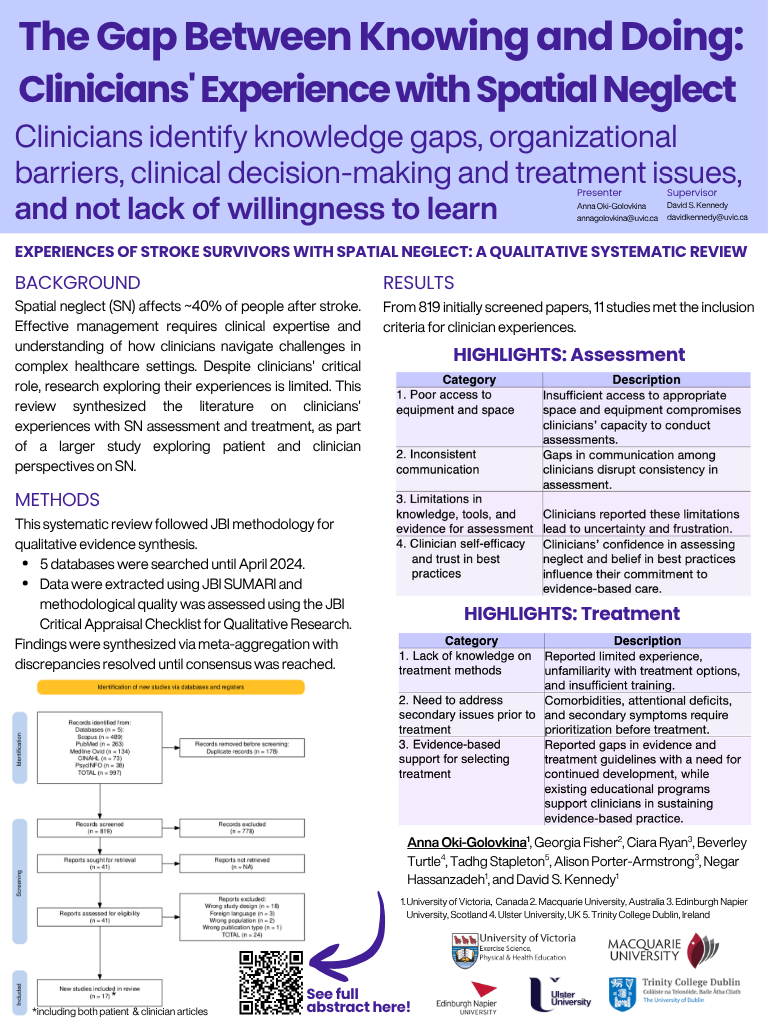
Methods: This systematic review followed JBI methodology for qualitative evidence synthesis. Five databases were searched until April 2024. Data were extracted using JBI SUMARI and methodological quality was assessed using the JBI Critical Appraisal Checklist for Qualitative Research. Findings were synthesized via meta-aggregation with discrepancies resolved through discussion until consensus was reached.
Results: From 819 initially screened papers, 11 studies met the inclusion criteria for clinician experiences. Three categories emerged regarding assessment: 1) knowledge of SN, including types and differentiation from other impairments; 2) environmental and organizational structures affecting assessment; 3) clinical decision-making in neglect assessment. For treatment, four categories emerged: 1) lack of knowledge of neglect and treatment methods; 2) environmental and organizational structures affecting treatment; 3) reasons for selecting treatment methods; 4) practices and perceptions of available treatment.
Conclusion: Clinicians report knowledge limitations, environmental constraints, and decision-making challenges with SN. Despite its prevalence, widespread knowledge gaps and structural barriers impede optimal care, emphasizing the need for improved resource allocation and enhanced clinician education.
*This systematic review has been divided into two abstracts for the World Stroke Congress 2025: Patients’ experience and clinicians’ experience.
Visit link to view Moving from Denial to Discovery: The journey from anosognosia to adaption
Visit nprlab.uvic.ca for updates from the Neurological Pain and Rehabilitation Lab at the University of Victoria.